
FIPS 201 Compliance: What Federal Buyers Actually Ask in 2026?
November 17, 2026 – From the desk of Trent White
If there’s ever been a learn-as-you-go career, selling into the federal access control market is it. Compliance and budget often collide, and budget often wins. Where can you make adjustments to fit this round compliance peg into the square budget hole? What do you really need to be FICAM (Federal Identity, Credential, and Access Management) compliant? I’ve highlighted some of the most common questions I hear—from newcomers bravely entering the market to access control veterans working with facilities upgrading their systems, moving toward FICAM compliance, and looking for a refresher on all things FICAM.
FICAM is more a standard than a product
There is no FICAM product to buy. FICAM compliance means the access control system cryptographically authenticates federal credentials (PIV, CAC, PIV-I, and TWIC) at the door, as FIPS 201 and NIST SP 800-116 intend. In practice, the system must prove the card is genuine, confirm its certificate chain traces back to a trusted federal authority, and confirm those certificates haven’t been revoked, every time it matters.
That is a different job from reading a number off a badge and comparing it to a database, which is what most access control systems were originally built to do. Compliance is the gap between those two behaviors, and closing it mostly depends on public key infrastructure rather than door hardware.
Education is the name of the game in the FICAM world. It’s for you and for your customers. The federal program manager or compliance officer for the agency you work with should know about FICAM, but other members of their team may not. There’s a lot to learn.
What do my customers need to do to be compliant?
In short, they need an approved system, designed by qualified people, and configured to the right authentication level for each area of the facility. Broken into steps, it usually looks like this:
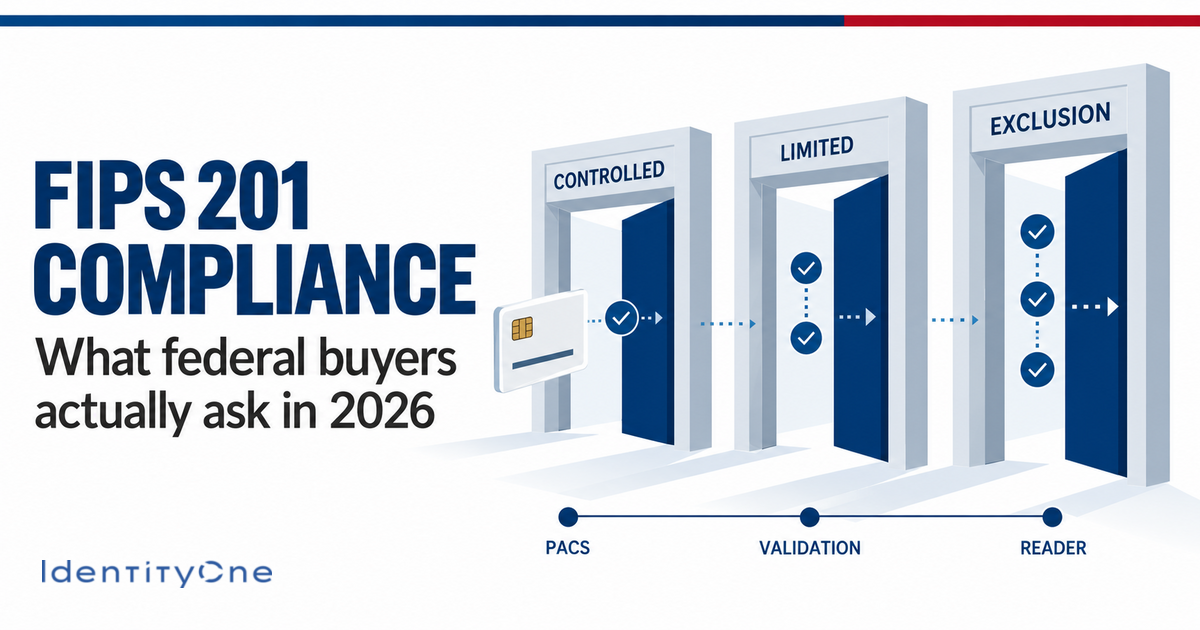
- Get very detailed on the facility risk assessment that classifies each area as controlled, limited, or exclusion, because that classification drives every later decision.
- Buy a complete solution listed on the GSA FIPS 201 Approved Products List, meaning the access control software, validation system, and readers are tested together.
- Have it designed and installed by a team that includes a CSEIP-certified engineer.
- Configure each door for the authentication mode its area requires, and register cardholders by validating their credentials at enrollment.
- Keep validating after go-live, which is the part most often forgotten and is covered further down.
Integrators often get caught off guard at step one. If the agency has not done the risk assessment, nobody can say what each door needs, and the bid ends up priced on guesses.
Do I need PIV readers at every door?
You need a PIV-capable reader at every door that controls access into federal controlled, limited, or exclusion space, but not necessarily at every opening in the building. Unrestricted areas, such as a public lobby or a parking structure outside the perimeter, are typically out of scope, and the risk assessment draws that line.
The trap here is assuming that a PIV reader on the wall makes the door compliant. A reader on its own is just one component, and it only counts when it is the model listed with the specific access control and validation system it was tested alongside. Swapping in a different reader because it was in stock can take an otherwise compliant door out of compliance.
What is the difference between FICAM compliant and FICAM ready?
“FICAM ready” is a marketing phrase, not a federal designation, and GSA does not certify anything as ready. The term gets used in different ways and often means that a customer has PIV readers in place and a validation has been “set up”, but they’re not fully validating the credential at registration or not doing ongoing validation with the right authentication level at the door.
What it doesn’t mean is compliant and when the right people start asking questions that can quickly lead to trouble.
A system is compliant when its access control software, validation system, and readers appear together on the GSA Approved Products List as a tested solution, and when that solution is installed and configured as tested.
What does ongoing validation mean?
Ongoing validation means the system keeps checking credentials after enrollment because a card valid at enrollment can be revoked months later. When an employee separates, or a card is reported lost, the issuing agency revokes its certificates, and the access control system must learn that and stop honoring the card.
In practice, the validation system rechecks the revocation status of registered credentials on a schedule set by agency policy, using the certificate authorities’ revocation lists or online status responders, and suspends access for anything that comes back revoked or expired. It also has to keep its trust anchors and certificate paths current as the federal PKI changes.
The catch for integrators is that this depends on network access and ongoing maintenance that are easy to leave out of the scope of work. A system that passed acceptance testing but cannot reach a revocation source six months later is quietly letting revoked cards through.
Does everything purchased need to be on the GSA APL?
Not everything, but the parts that “touch” the credential do. Federal acquisition rules require agencies to buy approved products for HSPD-12 implementations; for access control, that means the access control software and panels, the validation system, and the PIV readers. Door hardware, locks, cabling and power supplies are not listed, although the panel and reader models inside the tested solution are.
Do I need 13.01 or 13.02? Does it matter which one?
Both are fully approved topologies, and GSA treats the overall functionality as identical. The difference is architectural: a 13.01 solution uses two separate pieces of software, one for access control and one for validation, while a 13.02 solution handles both in the same software. Each is listed alongside the readers it was tested with.
For the buyer, the combination matters far more than the topology. It matters more for flexibility: a 13.01 approach lets an agency keep an access control platform it already knows and add a dedicated validation layer, rather than replacing the whole system. If your customer’s access control platform has a built-in validation system, a 13.02 topology might be the best path.
Do I need a CSEIP certified engineer on staff?
For most federal access control work, yes. GSA requires that work on approved access control systems in GSA-managed facilities be designed and installed by a Certified System Engineer ICAM PACS (CSEIP), and integrators offering this work under the relevant GSA schedule category must have at least one CSEIP-certified employee. There are agencies outside GSA-managed space and government adjacent industries that write the same requirement into their own contracts.
Getting it right the first time
Most of the surprises on federal access control projects come from treating compliance as a product feature instead of a property of the whole system, from the risk assessment through the validation that keeps running long after acceptance. Identity One’s FIPSlink handles that validation layer, so the access control platform and the readers can meet FIPS 201 without either one carrying the cryptography on its own.
If you are scoping a federal project and want an extra set of eyes on the design, or you have a question I did not cover here, reach out to our team at sales@identityone.net.